Viridescent - Espirt de la Nature

A fruity-green resinous incense to lift the spirit and bring joy to the heart.
Viridescent was created around the classic base of Frankincense, Benzoin and Myrrh with a surprising fresh aroma; lime-green, water-sweet with hints of flowers, musk and spices drifting through a warm resinousness.
Ingredients: Boswellia Occulta Frankincense resin, Balsam Fir resin, Balsam Fir needles, Black Benzoin resin, Kua Myrrh resin, Cardamon seed pods, Tree Mosses, Osmanthus Flowers, Nagkesar seeds
I often test incense and individual aromatic ingredients during my daily yoga practice. This ritual is my time to gently notice the sensations in my body, quiet my mind and recognise what I need. I have found that it is also an ideal time to discover the psychoactive qualities of botanicals I use for incense. It was in Adho Mukha Svanasana (Downward Dog) that I first inhaled agarwood, my mind melted into a calm pool, and I understood its desirability went far beyond its scent. Laying on my back in Supta Baddha Konasana (Reclining Bound Angle Pose), I discovered that Monkshood Lichen offered the same relaxing body and calming mind effects as Agarwood. I have sniffed a great deal of Frankincense in my life and believed I knew its calm mind and body glow. So, I was surprised when I put some Boswellia occulta Frankincense. What struck me first was its lime-green, water-sweet aroma reminiscent of green grapes glistening on a silver platter decorated with perfumed flowers. Flowers that like Night Blooming Jasmine and Osmanthus, which are very unusual to find in resins. Then, as I rolled myself into Hanasan (Plow Pose), I became aware of a sensation of joy that was spreading from the top of my head downward. A sensation distinct from the calming radiance I get from other Frankincenses.

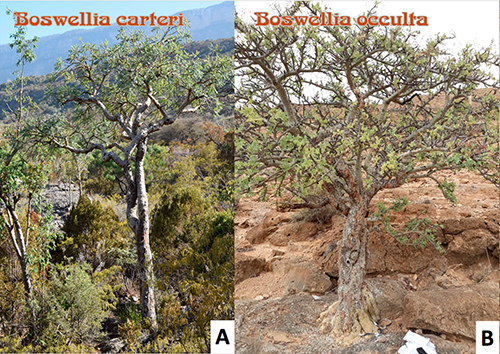
A little digging revealed that Boswellia occulta is quite new to Western awareness. For ages, this African resin stayed close to home, used by locals or sent across the Gulf of Aden to Arabia. But starting around 2015, the war in Yemen, which is located on the other side of the Gulf from Somalia, closed traditional trading routes to the Arab States. The resin, and its particular chemical makeup known as methoxyalkanes, started appearing as a fragrant abnormality in the quality testing for essential oil distillations. Methoxyalkanes and their unique aroma profile appear very rarely in nature. So far, they have been found only in the silk of golden orb spiders, where the chemicals provide flexibility and resistance to environmental factors, and in millipedes as a kind of “raincoat” to protect them from environmental moisture and desiccation. It is likely that B. occulta trees also evolved to produce methoxyalkanes against environmental stresses. The abnormality of methoxyalkanes in the quality control reports sets universities, research groups, and essential oil companies searching for the source of the trees. They were led to a cluster of trees that grow only in a small area of Somaliland at a lower altitude than other Frankincense trees. In observing the trees in situ, the researchers also discovered that the B. occulta trees are unmistakably different from the other frankincense trees of the region. B. occulta has smooth gray bark and hairless, simple leaves (one leaf per attachment) and, nothing like the shaggy bark and downy, compound leaves (many leaves creating a frond effect) of the more familiar B. carteri. According to intergenerational knowledge among local harvesters, these trees always produced a gum resin with a different scent from that of the others in the region. In light of B. occulta’s uniquely aromatic and psychoactive properties, it is understandable that its scarce resin was kept within local circles and seldom entered wider trade.
I immediately knew I wanted to craft an incense around the fragrance and sensations of B. occulta. So, I let myself fall into the daydreaming, free-association state that is my art of incense process. From there, I searched the halls, rooms and nooks of my scent memory mansion, for ingredients that evoked a similar joy and could echo or support B. occulta’s singular aroma. These are the botanicals I took down from the shelves.
Balsam Fir resin and needles support the lime fresh aspects and mood-elevating aromatherapeutic properties of B. occulta
Indonesian Benzoin is part of the classic temple blend of Frankincense, Myrrh and Benzoin that creates an olfactive and emotional balm for the soul. I opted for dark Indonesian Benzoin, feeling that its dried-fruit and vanilla notes pair naturally and with B. occulta’s own fruity aromas.
Kua Myrrh is the other part of the classic temple blend. Unlike the usual bitterness of myrrh, Kua Myrrh is mellow and balsamic, with a buttery, almost creamy cherry note that deepens B. occulta’s fruitiness.
Green Cardamon mirrors B. occulta in its bright, green-fruity freshness and gentle balsamic warmth. Even more than the aroma, the sense of joy I get from smelling cardamom seeds feels almost identical to the feeling B. occulta evokes.
Osmanthus Flowers also have a similar aromatic vibration to B. occulta with their watery, floral, fruity-nectar scent. Like B. occulta, smelling osmanthus flowers always brings me joy.
Nagkesar is the “Nag” in the original Nag Champa incenses. The seeds have an aroma that is a sweet, floral wood aroma with mild spicy and resinous undertones. Smelling Nagkesar seeds brings me an uplifting energy very reminiscent of the mood I experience with B. occulta.
Tree Mosses contribute weight, stillness, and stability to the blend which may sound counter-intuitive. Yet, I find that a hint of the opposite tone to a blend often intensifies the overall sensation. The chemical fusion of the citrus, floral, and spicy notes with tree mosses creates a synergy that lifts the mood and opens the mind.
Methoxyalkanes are also used as intermediates in organic synthesis, where the methoxy group can be selectively removed or modified to reveal other functional groups, serving as a protecting group.
In the pharmaceutical and fragrance industries, methoxy-containing compounds are valued for their ability to modulate solubility, bioavailability, and pharmacokinetic properties of drug molecules, as well as influence the scent profile of fragrances by affecting volatility and polarity.
The chemical compositions of B. occulta oleogum resin essential oils are markedly different from those derived from other Boswellia species (Table 2). Methoxyalkanes are exceedingly rare as natural products; they have never been reported as a plant product, to our knowledge, but have been isolated from spider silk,6,7 millipedes,8 and potentially microbes
Additionally, methoxyethane has been investigated for use as an anesthetic
pharmacokinetic - It is often described as "what the body does to a drug" and involves the time course of a drug's movement into, through, and out of the body. How the body interacts
particular Boswellia trees growing at a lower altitude than in the rest of the Sanaag region. According to the inter-generational knowledge of local harvesters, these trees always produced a gum resin with a different scent compared to the others in the region.